
Blog
Harry Potter Books in Order

⚡ QUICK ANSWER:
To read the main Harry Potter books in order, you must follow the chronological release sequence. The series begins with Harry Potter and the Sorcerer’s Stone and concludes with Harry Potter and the Deathly Hallows. Following this specific 7-book progression ensures you experience the narrative arc exactly as J.K. Rowling intended.
Introduction
Picking up a massive fantasy series can feel incredibly overwhelming when you do not know where to start. For many readers, the legendary Wizarding World poses a classic dilemma: do you read by release date or narrative timeline?
Fortunately, navigating Hogwarts doesn’t require a Marauder’s Map. In my experience auditing fantasy book series, the best way to read these novels is in the exact order they hit shelves.
This comprehensive guide lays out the correct sequence, details what to expect from each installment, and identifies which spin-off books are actually worth your time.
📢 QUICK FACTS — Harry Potter Books
- The core Harry Potter series consists of exactly 7 main novels.
- Harry Potter and the Sorcerer’s Stone was originally published as Harry Potter and the Philosopher’s Stone in the UK.
- The entire main book series spans a total of 4,100 pages, depending on the publisher’s edition.
- Word counts grow from 76,944 words in book one to over 257,000 words in book five.
- J.K. Rowling penned three official companion textbooks for charity, which belong to the extended canon.
The 7 Core Harry Potter Books in Order
🔑 Key Takeaway: The core narrative follows Harry’s seven years of education at Hogwarts School of Witchcraft and Wizardry, making the release order identical to the in-universe timeline.
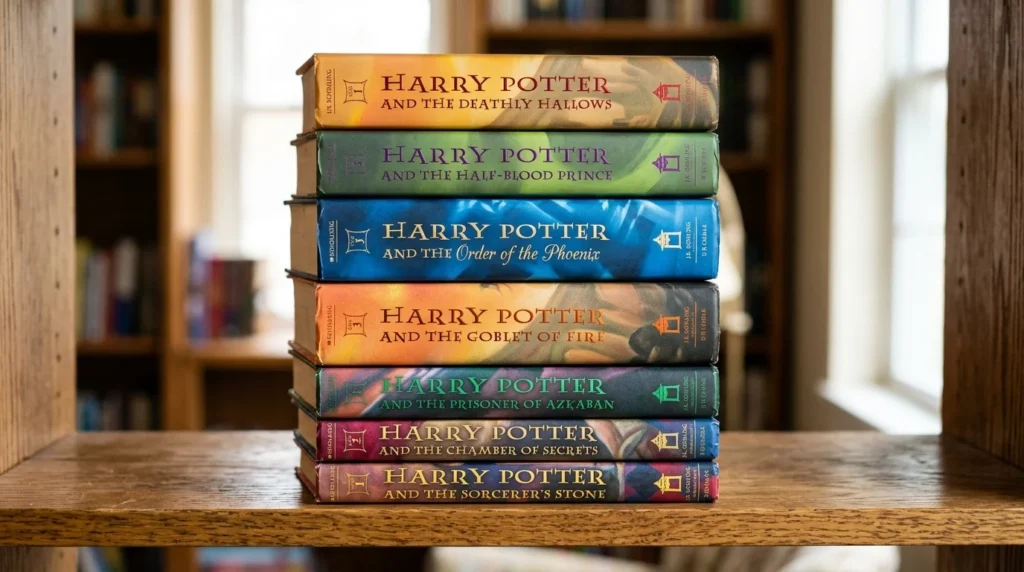
To experience the gradual shift from whimsical children’s literature to complex, dark fantasy, follow this exact order:
- Harry Potter and the Sorcerer’s Stone (1997)
- Harry Potter and the Chamber of Secrets (1998)
- Harry Potter and the Prisoner of Azkaban (1999)
- Harry Potter and the Goblet of Fire (2000)
- Harry Potter and the Order of the Phoenix (2003)
- Harry Potter and the Half-Blood Prince (2005)
- Harry Potter and the Deathly Hallows (2007)
Deep Dive into the Core Series Plots
🔑 Key Takeaway: Every book represents one consecutive year in Harry Potter’s life, showing deep character growth and high-stakes magical progression.
Harry Potter and the Sorcerer’s Stone
This book introduces an orphaned boy who discovers his magical heritage on his eleventh birthday. He leaves his cruel aunt and uncle to attend Hogwarts. Here, he makes lifelong friends and faces the dark force that killed his parents.
Harry Potter and the Chamber of Secrets
During his second year, a mysterious entity begins petrifying Muggle-born students. Harry must find the hidden chamber to stop the threat. This entry deepens the lore surrounding the dark past of the school.
Harry Potter and the Prisoner of Azkaban
An escaped convict named Sirius Black targets Hogwarts. Harry learns painful truths about his father’s past and his connection to the escapee. This is the only book where Voldemort does not directly appear.
Harry Potter and the Goblet of Fire
Hogwarts hosts a legendary magical tournament. Harry is mysteriously selected to compete despite being underage. The tasks test his limits, culminating in a dangerous turning point for the entire community.
Harry Potter and the Order of the Phoenix
The magical government denies the return of Voldemort, leaving Harry isolated. A secret resistance group forms to combat the rising darkness. This book features the longest page count in the entire franchise.
Harry Potter and the Half-Blood Prince
Harry uncovers Voldemort’s past secrets using an old, annotated textbook. As lessons turn dark, tragedy strikes the school, preparing the young wizard for an inevitable final war.
Harry Potter and the Deathly Hallows
The final installment follows the core trio as they skip their last school year to hunt magical artifacts. Their quest leads to a massive, decisive battle that concludes the overarching storyline.
The main Harry Potter books in order follow the lifecycle of Harry’s schooling. Beginning with the Sorcerer’s Stone in 1997, the core seven-book timeline runs consecutively through to Deathly Hallows in 2007, with each book matching a calendar year in the wizarding world.
| Book Title | Publication Year | Page Count (US Edition) |
| Sorcerer’s Stone | 1997 | 309 |
| Chamber of Secrets | 1998 | 341 |
| Prisoner of Azkaban | 1999 | 435 |
The Extended Wizarding World Books
🔑 Key Takeaway: Companion materials offer deeper historical world-building but should only be consumed after completing the main seven novels.
The Cursed Child Script Book
Harry Potter and the Cursed Child is a formal two-part stage play. It takes place nineteen years after the final book. While marketed as the eighth story, it is a script rather than a standard prose novel.
The Hogwarts Library Textbooks
Rowling wrote three short companion books to mirror actual textbooks mentioned in the series. These provide excellent lore additions for dedicated enthusiasts:
- Fantastic Beasts and Where to Find Them
- Quidditch Through the Ages
- The Tales of Beedle the Bard
Common Mistakes When Reading the Series
A common mistake I see among new readers is trying to insert the Fantastic Beasts screenplays before the main series. While Fantastic Beasts functions as a historical prequel, the text assumes you already understand complex magical mechanics. Starting there ruins the natural sense of wonder built into the first novel.
Another issue is confusing the British and American editions. Philosopher’s Stone and Sorcerer’s Stone are the exact same book; only the title and minor cultural phrasing differ. Do not accidentally purchase both, expecting distinct stories.
What’s New in 2026
The literary world continues to celebrate this universe with fresh special editions. Scholastic and Bloomsbury recently issued anniversary editions featuring updated cover art and exclusive house-themed illustrations. These new printings maintain the original text while providing fresh visual contexts for collectors.
Additionally, interactive digital reading experiences have expanded across modern devices. Enhanced e-books now offer animated drop-caps and moving illustrations that bring the classic text to life for younger audiences.
Final Thoughts
Reading the classic Harry Potter series in its proper sequence ensures you experience the narrative scale exactly as it evolved. Start with Sorcerer’s Stone, stick to the core seven novels, and save the companion textbooks for a fun deep dive later.
If you are ready to begin this reading journey, secure a copy of the first book and step onto Platform $9\frac{3}{4}$ today.
📌 “This article is reviewed and updated every 6 months to ensure accuracy.”
❓ Frequently Asked Questions (FAQ)
It is not recommended. While the story takes place earlier historically, the narrative relies heavily on lore, spells, and world-building established in the original books.
The book was released as Harry Potter and the Philosopher’s Stone in the UK. The publisher changed it to Sorcerer’s Stone for American audiences to sound more explicitly magical.
No, it is a published rehearsal script for a two-part stage play. It does not feature standard narrative prose or novelistic formatting.
The core seven books contain roughly over one million words in total. Order of the Phoenix is the lengthiest individual book in the collection.
The early books target readers aged 9-11. However, the tone, themes, and complexity mature alongside the characters, appealing to young adults and older readers by book four.
No, they are optional additions. Books like Quidditch Through the Ages provide fun historical context but do not alter the main storyline.
Harry Potter and the Order of the Phoenix is the longest book, containing 766 pages in the standard US hardcover version.